How to Choose the Best Lithium Ion RV Battery?

Time:2026-11-12 Author:Amelia
0%

Choosing a Lithium Ion Rv Battery is not just a matter of finding the largest capacity or the lowest price. The right choice depends on how you travel, what your electrical system can support, and how much power your appliances use. A refrigerator running overnight, a water pump cycling at camp, and an inverter powering a coffee maker all place different demands on a battery.

Start with the basics. Check your system voltage, daily energy use, and available space before comparing models. Then look at usable capacity, continuous and peak discharge ratings, and the battery management system (BMS). These details help show whether a battery can handle real loads, not just an impressive product listing. Confirm that your converter, solar controller, and alternator charging setup are compatible with the battery’s requirements. Small mismatches matter.

Cold weather deserves attention. Some lithium batteries restrict charging below certain temperatures, while others include built-in heating. Read the manufacturer’s specifications rather than assuming every model behaves the same. Also compare warranty terms, support, weight, and installation guidance. A lighter battery can make handling easier, but it does not automatically make it the best value.

There is no universal winner. It depends. I would be cautious about choosing from capacity alone; that shortcut can overlook charging limits or inverter demands. A careful comparison gives you a clearer picture of cost, performance, and practical fit. This guide explains the key features to assess, the questions to ask sellers, and the trade-offs worth considering before you buy.
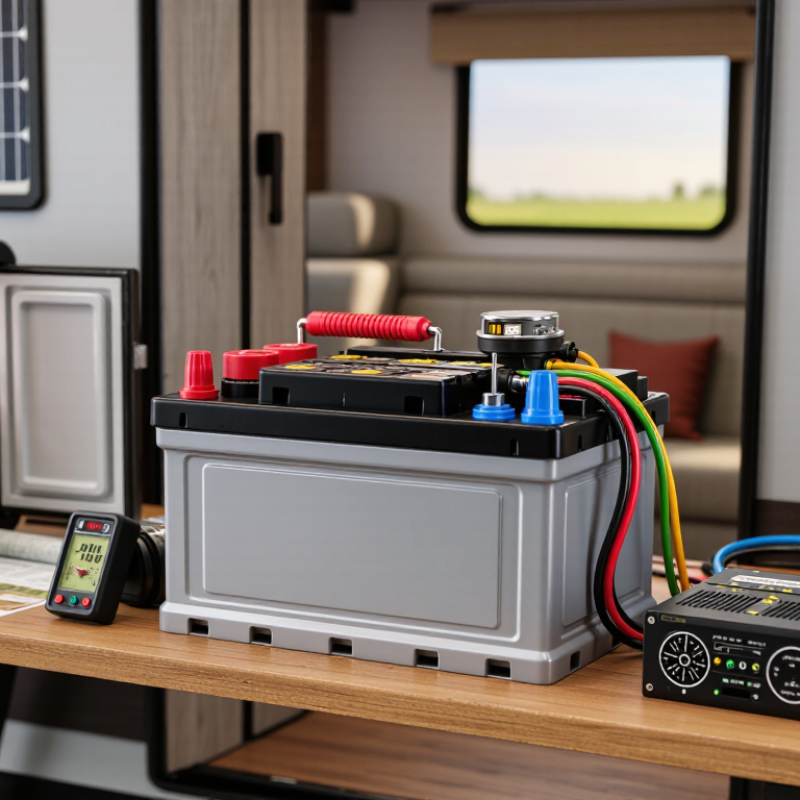
How to Choose the Best Lithium Ion RV Battery?

Understanding Lithium-Ion RV Batteries and Their Main Types

Lithium-ion is an umbrella term, not one exact battery chemistry. In RVs, the most common option is lithium iron phosphate, or LiFePO4 (LFP). It is valued for stable operation and long cycle life, which can suit daily use powering a refrigerator, lights, and a water pump. Chemistry matters. LFP batteries are often heavier than some alternatives for the same energy capacity, so weight and storage space still deserve attention.

Some lithium RV batteries use nickel manganese cobalt chemistry, often shortened to NMC. Its higher energy density can provide more stored energy in a compact, lighter pack. However, thermal management and battery protection are important design considerations. Not always the simplest choice. Actual performance depends on the complete battery system, not just the chemistry printed on its label.

A built-in battery management system helps monitor voltage, temperature, and charging limits. Check whether it protects against charging in freezing conditions; many lithium batteries restrict cold charging. Also confirm that the RV’s converter or solar controller uses a compatible charging profile. A “drop-in” fit may not mean every existing charger is suitable. Check carefully. Compare usable capacity, weight, warranty terms, and the maker’s technical specifications before deciding.

How to Choose the Best Lithium-Ion RV Battery

Understanding the nominal voltage of common lithium-ion battery chemistries is a useful first step when comparing RV batteries.

How to read this chart: LFP cells are typically rated at 3.2 V, NMC cells at about 3.6–3.7 V, and LTO cells at about 2.3 V. The chart plots 3.65 V for NMC, the midpoint of its typical range. These are cell-level values; RV batteries combine cells to match a system voltage. When choosing a battery, also compare usable capacity, battery-management-system protections, cold-weather charging limits, cycle life, and weight.

Calculating Your RV’s Daily Power Needs

Calculating Your RV’s Daily Power Needs

Start with a 24-hour load list, not the battery’s advertised capacity. Record each appliance’s watts and expected daily run time, then multiply watts by hours to get watt-hours. A 45-watt cooler running eight hours uses 360 Wh. Add lights, fans, pumps, device charging, and inverter-powered appliances. Small loads add up.

The U.S. Department of Energy reports that LED bulbs use at least 75% less energy than incandescent bulbs, so lighting choices can meaningfully change your estimate. Still, real run times vary with weather and habits.

For a practical example, a cooler at 360 Wh, a fan at 180 Wh, lights at 80 Wh, and phone charging at 30 Wh total 650 Wh per day.

At 12 volts, 650 Wh is about 54 Ah before losses.

Divide that figure by system voltage to estimate amp-hours: at 12 volts, 650 Wh is about 54 Ah before losses. NREL’s 2024 Annual Technology Baseline uses 85% round-trip efficiency for utility-scale lithium-ion storage; an RV setup is different, but the report is a reminder that stored energy is not delivered without losses. Don’t treat that figure as an RV specification.

Allow for inverter use and reserve capacity, then compare your estimate with actual monitor readings after a trip. My first estimate is usually wrong. Measure, then adjust.

Comparing Battery Capacity, Voltage, and Performance

How to Choose the Best Lithium Ion RV Battery?

Comparing Battery Capacity, Voltage, and Performance

Capacity

Capacity is useful only when matched to your daily loads. A 12.8-volt, 100-amp-hour battery stores about 1.28 kilowatt-hours before conversion losses. A 60-watt fridge running for 24 hours would use 1.44 kilowatt-hours if its compressor ran continuously. In practice, cycling changes that estimate. Measure actual use, including lights, water pumps, and inverter loads, rather than relying on appliance labels alone. Small details matter.

Voltage and Performance

Voltage must also suit the RV’s electrical system. A battery’s nominal voltage is not its full operating range; confirm that the charger, inverter, and monitor support the battery manufacturer’s specified limits.

For performance context, the U.S. Department of Energy’s 2022 Grid Energy Storage Technology Cost and Performance Assessment reports roughly 85% round-trip efficiency for lithium-ion storage systems. That is a grid-scale benchmark, not a guaranteed RV result.

Wiring, temperature, and charging settings affect real-world output. I would still leave a reserve: estimating every load perfectly is harder than it looks. Compare usable watt-hours, continuous and surge discharge ratings, and the battery’s low-temperature charging protection before choosing.

Checking Compatibility, Charging, and Safety Requirements

Choosing an RV lithium-ion battery starts with the equipment already installed, not just the capacity printed on a label. Check its nominal voltage against your inverter and DC loads. Confirm the battery’s dimensions, terminal layout, and continuous current rating, too. A unit may fit the tray but still fall short when an inverter draws heavily. I have learned that a close voltage match can hide other compatibility problems.

Charging needs equal attention. Check whether the converter, solar controller, and alternator charger support the battery’s required charging profile. Review the manufacturer’s limits for charging temperature; many lithium batteries must not be charged below a specified temperature. Cold matters. A built-in battery management system can disconnect the battery, but it does not make an unsuitable charger appropriate. Confirm that wiring, fuses, and connections match the system’s current requirements, and avoid combining batteries with different capacities or conditions unless the manufacturer permits it. Before installation, inspect cables for worn insulation and terminals for loose fits. One detail is easy to miss: RV charging systems vary, so a setting that works in one vehicle may not suit another. When specifications are unclear, pause and verify them with a qualified RV technician.

How to Choose the Best Lithium Ion RV Battery? - Checking Compatibility, Charging, and Safety Requirements

Selection Check What to Verify Practical Guidance
Battery chemistry Confirm the exact lithium chemistry and its operating requirements. Many RV house batteries use lithium iron phosphate (LiFePO₄), a lithium-ion chemistry. Charging voltages, temperature limits, and other requirements vary by chemistry and battery model.
System voltage Match the battery bank to the RV’s electrical system and equipment. A typical “12 V” LiFePO₄ battery has a nominal voltage of about 12.8 V. Check that the inverter, charger, monitor, and other equipment support the battery’s actual operating-voltage range.
Capacity and usable energy Compare capacity in amp-hours (Ah) with the RV’s daily energy use. Estimate daily watt-hours from appliances and use: watt-hours = watts × hours. A 12.8 V, 100 Ah battery has about 1,280 Wh of nominal energy; usable energy depends on the battery’s specified limits and system losses.
Continuous and peak current Check the battery’s continuous discharge rating, short-duration peak rating, and built-in battery management system (BMS) limits. The battery and BMS must support the expected inverter and appliance loads. Include inverter surge needs, and ensure cables, connections, and overcurrent protection are appropriately rated.
Charger compatibility Confirm that shore-power and onboard chargers have a lithium-compatible setting for the battery chemistry. For many 12.8 V LiFePO₄ batteries, the recommended absorption or charge voltage is often within approximately 14.2–14.6 V. Use the battery manufacturer’s specified settings; avoid lead-acid equalization or desulfation modes unless explicitly approved.
Float and storage charging Check whether the battery permits continuous float charging and what voltage it specifies. Some LiFePO₄ batteries do not require continuous float charging; others permit a particular float setting. Follow the battery and charger instructions rather than assuming a lead-acid profile is suitable.
Alternator charging Assess the alternator, wiring, and charging method before connecting a lithium battery bank. A DC-to-DC charger can provide controlled current and a lithium-compatible charging profile. Do not assume the vehicle alternator or existing wiring is suitable for the battery’s charging-current demand.
Solar charging Verify that the solar charge controller supports the battery chemistry and its required voltage settings. Set the controller according to the battery specifications. Check its maximum PV input voltage, charging-current limit, and compatibility with any existing battery bank.
Charge current Compare the charger’s maximum output with the battery’s permitted charge current and BMS limit. Use the battery’s stated maximum charge current, not a generic value. If several charging sources can operate at once, account for their combined current where applicable.
Low-temperature charging Check the minimum permitted charging temperature and whether the BMS provides low-temperature charge protection. Many LiFePO₄ batteries must not be charged below 0°C (32°F) unless specifically designed for cold-weather charging. Confirm the exact limit and whether any self-heating feature is included.
Temperature and installation location Review the specified charging, discharging, and storage temperature ranges, plus the approved mounting orientation. Install the battery in a secure, protected location within its stated limits. Keep it away from excessive heat, moisture, and physical damage, and follow the manufacturer’s enclosure and ventilation instructions.
Series or parallel expansion Confirm whether the battery permits series or parallel connections and how many units may be connected. Only combine batteries in configurations approved by their manufacturer. Use compatible batteries and follow instructions for cable sizing, connection layout, and balancing.
Fusing and short-circuit protection Check the required fuse or breaker location, current rating, interrupt rating, and cable size. Install suitable overcurrent protection close to the battery positive terminal, as required by the system design and applicable electrical rules. Lithium batteries can deliver high fault current.
BMS protections Review protection against overcharge, over-discharge, overcurrent, short circuit, and temperature extremes. Confirm the BMS ratings and behavior, including how the system responds if the BMS disconnects. A BMS does not replace correct fusing, wiring, or charger setup.
Monitoring and state of charge Check whether the RV monitor supports lithium settings and can be configured for the battery’s capacity. Voltage alone may not provide an accurate state-of-charge estimate for LiFePO₄ across much of its discharge range. A compatible shunt-based monitor can improve tracking.
Standards and documentation Review the battery’s safety documentation, certifications, warranty conditions, and installation instructions. Choose a battery with documentation appropriate to its intended RV use. Verify that installation and transport comply with relevant local requirements.

Note: Values shown are general selection guidance, not universal specifications. Always follow the battery manufacturer’s instructions and confirm compatibility with every charging source and connected device.

Evaluating Lifespan, Warranty, and Total Cost of Ownership

When comparing lithium-ion RV batteries, treat lifespan as a range, not a promise. Cycle ratings depend on discharge depth, temperature, and charging conditions. Real use can differ. A battery stored in a hot compartment may age faster than one kept cool and used moderately. Check the test conditions behind the rating, then compare them with your routine. Running a refrigerator overnight and recharging daily creates a different load pattern from occasional weekend use.

Read the warranty carefully. Note its term, covered capacity threshold, and required maintenance records. Some warranties exclude damage from unsuitable chargers, extreme temperatures, or incorrect installation. A long warranty sounds reassuring, but coverage details matter more. Small print matters. It is easy to focus on years of coverage and miss what counts as normal wear.

Estimate total cost of ownership over the years you expect to keep the RV. Include purchase price, compatible charging equipment, installation, and likely replacement timing. Then compare cost per usable kilowatt-hour, not just the label capacity. A lower-priced battery may cost more if less energy is available or replacement comes sooner. I would still leave room for uncertainty: actual service life depends on use, storage, and charging habits, and no spreadsheet can predict every trip.

FAQS

What does “lithium-ion” mean for an RV battery?

It describes several chemistries. LiFePO4 is common in RVs and is valued for stable operation and long cycle life.

How does LiFePO4 differ from NMC?

NMC can store more energy in a compact, lighter pack. LiFePO4 may weigh more for similar capacity. Design matters, too.

How can I estimate my daily power use?

Multiply each appliance’s watts by its daily run hours. A 45-watt cooler running eight hours uses 360 watt-hours. Small loads add up.

How much energy do common RV appliances use in a day?

One example totals 650 watt-hours: cooler, 360; fan, 180; lights, 80; phone charging, 30. Your actual use may differ.

How do I convert watt-hours into amp-hours?

Divide watt-hours by system voltage. At 12 volts, 650 watt-hours is about 54 amp-hours before losses. Leave room for reserves.

Can I keep using my existing RV charger?

Check that the converter, solar controller, and alternator charger support the battery’s charging profile. A drop-in fit does not guarantee compatibility.

What should I know about charging in cold weather?

Many lithium batteries restrict charging below a specified temperature. Check the battery limits and its management system. Cold matters.

What should I check before installation?

Confirm voltage, dimensions, terminals, and continuous current rating. Inspect cables for worn insulation and terminals for loose fits. Ask a qualified technician if specifications are unclear. My first estimate may be wrong; measuring after a trip can reveal what I missed.

Conclusion

Choosing the best Lithium Ion Rv Battery starts with understanding the main battery types and how their features suit different travel styles. Estimate your RV’s daily electricity use by listing the appliances and devices you expect to run, their power requirements, and how long they’ll be used. This gives you a practical basis for selecting battery capacity and helps avoid paying for more storage than you need—or running short of power.

Next, compare voltage, usable capacity, and performance under your expected conditions. Check that the battery is compatible with your RV’s electrical system and charging equipment, and review its safety requirements before installation or use. Finally, consider expected lifespan, warranty coverage, and the total cost of ownership, not just the initial price. A careful comparison of these factors can help you choose a reliable battery that fits your power needs and supports your RV plans over time.


Amelia

Amelia

Amelia is a seasoned marketing professional with a wealth of expertise in our company’s core offerings. With an unwavering passion for driving growth and innovation, she plays a pivotal role in shaping our marketing strategies and enhancing brand visibility. A key aspect of her responsibilities......